Showing posts with label Emily Dickinson. Show all posts

Thursday, January 19, 2012

LoL: Lots of Labels

Skunk Hour - Robert Lowell (the village creep)
post-discussion

Probably not intended as a personal outing. But you know. Maybe.

The skunks were rather underrepresented in my interpretation; the mother skunk's nurturing side makes them the characters with the most enviable familial ties in the poem.

"I myself am hell" is a line from Paradise Lost.

This is an example of confessional poetry because it is a glimpse into the life of the poet himself.

The tone is lonely, cynical, melancholy and hopeless.


Acting Like A Tree - Jonathan Aaron
"How to Make a Company Party Bearable and Be with the Wolves"

I wasn't actually far off on this one. I neglected to use the word "anthropomorphism" and note the alliteration in "red ribbon of a river," and I didn't know that there was a tradition of humans becoming trees that pertains to a name I don't think I caught that sounded like Avid.* But this guy. He didn't need to be with people because he was rich inside his head.


Because You Asked about the Line Between Prose and Poetry - Howard Nemerov

The title is interesting because it's a sentence fragment and creates a conversational tone, and the reader expects an answer to the question he never actually asked, and he probably expects it in the form of a definition.

The last stanza is a rhyming couplet, and prose falls while poetry flies.


Also, it was recommended that we read Emily Dickinson's poem that begins with the line, "A bird came down the walk."

*Ovid. Metamorphosis. That was silly.

Friday, July 8, 2011

"Writing is making sense of life." - Nadine Gordimer

"'I should like a thoroughly bad climate,' he answered. 'I believe one would write better if the climate were bad.'" - p. 229

It's true, I think. I find that terribly worrisome, considering my career objectives. Let's look at some examples.

J.K. Rowling is the richest woman in the world. She's got more money than the Queen of England. Everyone loves her, with the exception of people who think that Harry Potter is either annoying or evil.

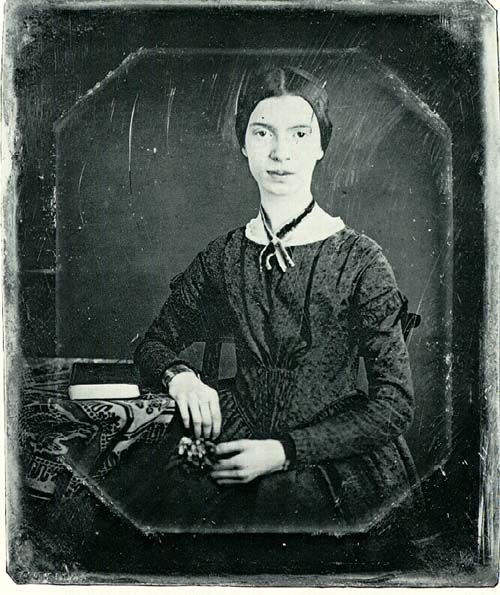
Emily Dickinson, about whom I wrote my Famous American report in third grade (and also one in seventh), is, for all her confusing capitalization, one of the most-read poets of all time.

Charles Dickens... well, we've all read some Dickens at some point in our lives, haven't we?

You know what they all have in common? They're all varying degrees of miserable.

J.K. Rowling, after moving back to England from Portugal with her daughter as a single mother, wrote the beginning chapters of Harry Potter on napkins in pubs while her baby daughter napped.

Emily Dickinson was a hermit. She was also depressed.

Charles Dickens described himself as a "very small and not-over-particularly-taken-care-of boy."

For the sake of avoiding unnecessary mental crises, I am going to stop there.


I have this autographed picture on my desk in my room. Sometimes people think it's a new frame that still has the random picture in it.

Thursday, December 16, 2010

Never eat raspberries.

Otay, my adaptation is for "A Rose for Emily."

Just so you know.

Point of View
I'm changing the point of view to Homer's because I don't like this communal townspeople point of view business that Faulkner tries to pull off. Also, I like the idea of getting into Homer's head. We know that Emily has a thing for him, but what does he think of her? We would also get to see Emily from an objective point of view, but one that still allows for indirect characterization. This would become Homer's story, not Emily's. Also, I want it to be omniscient, so there's no bias in Homer's perspective, but I the camera should primarily follow him around. Since he ends up dead, this would also make the story into a horror movie. Watch out.

Setting
Remember how I said "A Rose for Emily" reminded me a lot of the story of Annie Palmer? She lived in Jamaica, and I think it adds to the spookiness if the movie takes place in a country foreign to where it's released. The time period would be contemporary, which I think makes it more personal, and thus scarier. I think Emily would have to be on the rich side of things; in Jamaica, there's an enormous gap between the rich and the poor. Maybe Homer is on the poor side, and that could be a small part of his motivation for friendship, as well as her father's disapproval. This would be a source of gossip in the town, I suspect, which could be a backdrop to the plot, but not a major dynamic like it is in the short story.

Characterization
I've got the major cast members aaaaaaall figured out:
Homer will be played by Usain Bolt. He seems like quite the catch. Ahahahahaaaaa it's a pun. Sort of.
Also, I decided that Emily is the Jamaican-born daughter of her British father. She's played by British-Jamaican actress Noemie Harris.
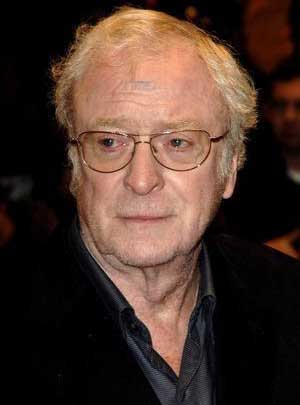
Her British father's played by Michael Caine.
That's much better than my original mental image:
But in terms of AP Lit characterization, they'll all be a whole lot more Jamaican. The cultural twist will probably leak into every element of the story. They'll speak with Jamaican accents. They'll eat "patties" a lot, probably. Erm... bright colors might be prevalent in their wardrobe. I feel like I'm stereotyping.
Plot
Emily's still gonna keep her dad's dead body and then kill Homer and keep him around and whatnot as well. I'm not into the whole Minority Report change-everything-except-the-lead-character's-name thing. Howeverrrr, I'm going to leave out that bit about Emily needing to pay taxes. I think the Homer/Emily/dad story is more intriguing without the distraction of the town. Also, I want an actual rose in the story. I'll work that in by having a rose arrive at Emily's door that's from Homer, who had it sent there as a surprise. Emily's never going to fiiind it, though, because she'll never leave her house again after she kills Homer. It'll just sit there on her front doorstep, and she'll die like Bartleby, never knowing it's there. It's one of those everybody-dies-in-the-end movies that I hate.
Theme
The theme, of course, will be considerably different at this point. In Faulkner's story, the theme is something like, "Love makes us do crazy things." In my version, that will still be there. Howeeeever, it's a horror story, so the new theme is "Watch your back." (Not literally.) I want more thrill, the same amount of creepy, and slightly less sentimentality. There's plenty of room for that in chick flicks. I want the viewers to leave with the thought, "I sure hope I never have a crazy significant other who kills me and hoards dead bodies."

Thursday, September 23, 2010

Crayola washable kids' paint.

The tone of "Much Madness is Divinest Sense" is satirical, methinks. (*points at question eight*) Dickinson isn't really the dry humor sort, though, so it's not a particularly amusing satire, and I think there's some expectation of that in most satire, so I'm conflicted. Her speaker definitely seems to be calling for change, though. She wants to ensure that people don't just blindly accept things. Sense is madness, and the majority is sensible, but she wants to show that the crazy minorityis in the right.

She does recognize the risks involved, though. "Demur--you're straightway dangerous,/ And handled with a chain." Straying from the norm hasn't worked to the advantage of most of our famous examples. They're usually the ones who bring about the big changes that keep our world from plummeting into irrevocable doom, though, so we need those guys.

Thursday, September 16, 2010

Butterfly Shots

This is the part where Emily Dickinson is high on life. That was my first reaction, anyway.

Now's as good a time as any to say that, in response to question two, I kind of feel like the speaker is Emily Dickinson. It's not necessarily the case, but she just doesn't seem the type to write from another's perspective. She was sort of disturbed, I think, and she wrote poetry to express that in a healthy way. That's why I was surprised, though, by the optimistic tone this poetry seemed to take.

I had inferred that life was the never-brewed liquor of which she spoke. Some people said, more specifically, nature, which probably makes more sense but is less relatable, I feel. Most people just don't get that excited about nature, in my experience. I guess Emily Dickinson wasn't "most people."

As my dear friends Kahle and Christian have already pointed out, "Vats upon the Rhine" refer to wine which originates from the vineyards along the Rhine. Rhine wine. Aha. Perhaps, though, she is more excited about the flowing of the Rhine and the blooming/blossoming/whatever-the-grapes-do of the grapes. So the occasion (question four) is just an ordinary day's appreciation of nature.

I guess the theme (question seven) would have to be appreciation of nature and also maybe fear of judgment. Dickinson was agoraphobic by nature, so it's fitting that she mentions the "Saints" running to windows to watch her as she makes something of a fool of herself.

Also, the setting (question five) is outside during the daylight, which we know because of her "Leaning against the--Sun--." I have a severe distaste for her ending of poems with random dashes as though she just gave up on concluding her thoughts. Oh well. I interpreted that to be her sort of final detachment from reality in her never-brewed-liquor-induced tipsiness. It's as though she's falling up against the Sun because the world is spinning all around her.


"I tripped on my shoelace,
And I fell up.
Up to the roof tops,
Up over the town,
Up past the tree tops,
Up over the mountains,
Up where the colors
Blend into the sounds.
But I got me so dizzy
When I looked around,
I got sick to my stomach
And I threw down."
--Shel Silverstein

Wednesday, September 8, 2010

Ambiguity?

As it turns out, I rather like this poetry. I remember writing my Famous American Day report on Emily Dickinson back in third grade and really wanting to like her poetry. I didn't, though. I also really hated the costume.


Since I'm apparently talking about Emily Dickinson, I'll go ahead and make this post about "I felt a Funeral, in my Brain."

Worth noting is the seemingly random capitalization; actually, she seems to have aimed for nouns, which is oddly German of her. In any case, her perspective, arguably, could be from the casket, or "Box," in question. If one takes that stance, then the funeral is her own. Although I feel that is the most satisfactory interpretation, this site says that she felt traumatized by several deaths which were not her own, which I suppose she might have had trouble removing from her brain.

This ambiguity receives no clarification from the abrupt end. Dickinson seems to either lose her mind or die, mid-thought. The cynic in me also includes the possibility that she merely grew bored or frustrated in the writing of that particular poem and tossed her pen aside. More likely, though, she lost her mind from the mourning for the funeral in her brain--a funeral which was likely a metaphor for the mourning itself rather than a literal funeral, as funerals aren't things to be "felt [in the] brain." If in fact the funeral she imagined was her own, she was already dead, and she can't be expected to die in the writing of this poem. At the same time, though, if she's dead, can we expect her to be watching her own funeral anyway? Well... maybe.